|
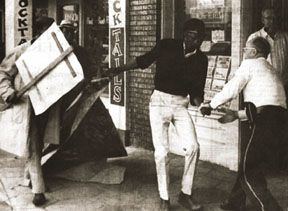 (Above) 1966 - Chairman Omali is arrested after tearing down racist mural on display at St. Petersburg City hall Chairman Omali's Roots in St. PetersburgChairman Omali summed up the significance of the period in which he was born and how that had influenced him and the working class nature of the Uhuru Movement and the African People's Socialist Party: "I am from a really important generation that was born during a particular transformation of the economy in the U.S. and the world. It was the period of the development of the urban working class. "Our movement in the 60s was the first since the Garvey Movement of the 20s which had class consciousness. Malcolm X spoke as a conscious representative of urbanized African workers, and this influenced my understanding of the world. "There was something about my generation. I was among the most recent generation born into an urban working class. "My father had worked in Georgia. He came to St. Petersburg during the depression. This was an urbanized area compared to other parts of the rural South, and there was a great difference between the worldview of myself and my father who was from the share-cropping peasantry. I was of the generation of Huey Newton who went from rural Louisiana to urbanized Oakland where he started the Black Panther Party, an organization of the African working class. "The transformation of the world economy created the urbanized working class throughout the colonized world and inside the U.S. as well. Thus we saw the rise of the national liberation movements in Africa, Korea, Cuba, Vietnam-and inside the U.S., as the Civil Rights Movement was claimed by the African working class and transformed into a movement for Black Power." Omali Yeshitela was born as Joseph Waller to Joseph and Lucille Waller on October 9, 1941 in St. Petersburg. His father was a railroad worker and his mother a beautician. His grandmother was the most important force in his early life. Helping him to read the newspaper when he was barely out of diapers, teaching him to reject aspirations of personal gain and wealth, and priming him for a life of leadership and commitment to the struggle of African people.  Chairman Omali described his early influences "When I was about five, I remember telling my grandmother that I was wishing for a big car and a big house when I grew up. But my grandmother said, "It would be better for you to get those things for everybody, then you could be happy too as opposed to doing it just for yourself." "As a child they skipped me a graded and they tried to reward me with all kinds of badges and make me a snitch on the other children who might smoke, and I refused to do it. I could never do that! I couldn't see myself being separate from the people in that fashion." When he as 18, Joseph Waller joined the army where his political consciousness began to develop. He began to do some organizing in the army and started to take stands in defense of African people. He was discharged after being told by a military psychiatrist that he was "a Garveyite." When he returned to St. Petersburg, Joseph Waller was "filled with rage," and hungry to experience life and bring justice to African people. He got out of the army just as African workers, under the influence of Malcolm X, were about to transform the petty-bourgeois-led Civil Rights Movement into the explosive Black Power Movement. It was the events of the early and mid-sixties which charted the destiny of this talented and committed young African worker who would one day become Chairman Omali Yeshitela. This was the young man who would ultimately change the course of history for African and all oppressed people throughout the world. Joe Waller first worked with the NAACP Youth Organization and the Congress of Racial Equality (CORE) before becoming an organizer for the Student Non-Violent Coordinating Committee (SNCC). Traveling throughout Florida and other parts of the South, Waller built SNCC as a membership organization, engaging the local people to become organized to solve their own problems. A turning point came in 1966 when Waller led a demonstration of African people to the St. Petersburg city hall and ripped down a degrading and racist mural which hung in the lobby. For this courageous act he was charged with 11 counts and sentenced to five years in prison, however he gained the respect and admiration of the entire African community. 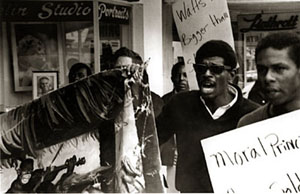 (Above) Chairman Omali marches through St. Petersburg streets after tearing down racist mural from City Hall walls. He had emerged as the leader of the African working class movement in St. Petersburg. The act of ripping down the vicious mural is still legendary in the people's minds in St. Petersburg, and city officials have never been able to replace the picture. The young Waller spent most of the next few years in and out of prison, often in the chain gang, on these and other charges, stemming from his political activity. While in prison in '66, he formed JOMO, the Junta of Militant Organizations, a militant working class organization similar to the Black Panther Party which also chose the Black Panther as its mascot. The ranks of JOMO swelled rapidly, The Burning Spear newspaper was born and Chairman Joe Waller became the dynamic young leader, loved by African People and their allies and hated and feared by the city government and the white power system. It was the period of Black Revolution of the 60s. All over the U.S., cities were burning and struggle for political power and independence. The U.S. government was involved in the illegitimate genocidal war against the heroic people of Vietnam and the Black Revolution inside the U.S. to have to fight on two fronts. By the end of the 60s the U.S. had implemented its deadly COINTELPRO program, which militarily defeated the Black Revolution. Some of the most important leaders had been assassinated, such as Malcolm X, Martin Luther King and the beloved Fred Hampton in Chicago. Most of the chapters of the Black Panther Party had been infiltrated by government agents and destroyed. The movement was being slandered and many organizers were being imprisoned. The U.S. was carrying out a full-scale counterinsurgency war against the Black Power Movement and the African population. It has always been the African working-class which bears the brunt of this violent and deadly counterinsurgency war. | ||||
| ||||