|
| ||||
| It was supposed to be a "unity march" endorsed by the city government, as if white people coming together with the African community to chant "give peace a chance" could ever heal the brutal October 24 police murder of 18-year-old TyRon Lewis-one murdered African too many and 400 oppressive years too long. Young TyRon was executed just two blocks away from the Uhuru House, and even before the police had fired the first shot, witnesses ran to the Uhuru House for reinforcements and leadership. After the murder, the African community rose up in a righteous rebellion that was politicized, focused and to-the-point. The brutality and viciousness of the police was no different than in other cities like Los Angeles, Pittsburgh or San Jose. What was different was that the people had the Uhuru Movement has worked tirelessly in St. Petersburg in the interests of the African working class for the past 30 years. Today, the Uhuru Movement has the trust and confidence of the African community primarily because of the commitment, work and leadership of one man: Omali Yeshitela. Because of him, the people have a model for the highest example of the courage, brilliance, stamina and determination of the African working class. He has truly earned the mantel of the people's leader, and the African community's love of Chairman Omali is deep and profound. 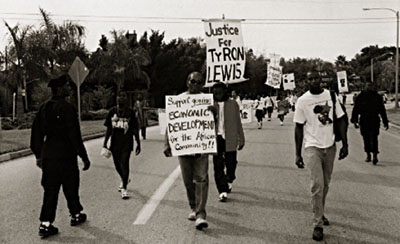 (Above) Chairman Omali leads Demonstration for genuine economic development to the African Community Throughout the days and weeks following the magnificent St. Petersburg rebellion, the government and the media worked overtime to try to isolate and target the Uhuru Movement and Chairman Omali himself. But by building the broadest base of support possible in the African working class agenda, Chairman Omali was able to turn the situation around. He helped build a coalition crossing class boundaries which united with the undeniable justice of the Uhuru Movement's demands in the name of the African working class: amnesty for all those arrested, prosecution of the killer police, reparations to the family of TyRon Lewis, and defense of the Uhuru Movement. The fact is that there was hardly anyone in the African community, regardless of class, who had not experienced some sort of attack by the police, nor was there anyone who did not have the deepest respect for Chairman Omali and the work he has led. By the time the Chairman stepped up on the stage at Williams Park to speak that Saturday afternoon, the feeling was unanimous among the Africans in the park and they were very vocal about it: Chairman Omali Yeshitela and the Uhuru Movement represented them and their highest aspirations for their whole people. It was clear to the city, the police and the media that they would no longer be able to isolate and attack the Chairman and the Uhuru Movement without bringing down the wrath of the whole African community.
| ||||

 l
l


