|
90s-A new era of crisis and resistanceBy 1991 Chairman Omali had called for the founding of a Revolutionary mass organization to build as broadly as possible, with the central goal of defeating the vicious counterinsurgency against the African community and defending the democratic rights of African people. Around this time Akua Njeri, the widow of the beloved Fred Hampton, the Illinois Chairman of the Black Panther Party came forward to embrace the African People's Socialist Party. 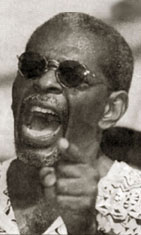 The Chairman was very moved by this courageous woman who, while more than 8 months pregnant, had survived the deadly police assault on December 4, 1969 which brutally killed Fred Hampton. Yet she had continued to struggle and raised her son, Fred Hampton, Jr., to follow in the footsteps of his father. The Chairman nominated Akua to be the president of the National Movement (NPDUM) and the founding convention was held in April, 1991. Despite contradictions, NPDUM has proved to be a fundamentally important organization in defining and stopping the counterinsurgency against African people. As the 90s have unfolded, the Party moved its national office back to St. Petersburg where it has continued to work tirelessly among the masses of African people, organizing every day around all of the life and death issues affecting the class. During this period the Party has put a lot of effort into building institutions which create economic self-reliance for the party and the African community. The most successful Party institutions today include Uhuru's Black Gym of Our Own in St. Petersburg, and the two Uhuru Furniture stores coordinated by the African People's Solidarity Committee, one in Oakland and one in Philadelphia. The Fourth Party Congress is scheduled for February 1997 and will finally put in place the Chairman's long held dream of building the African Socialist International, the coordinating organization that will unite and give leadership to Africans struggling for liberation anywhere in the world. Today the rebellions in St. Petersburg in October and November, 1996 have helped create a whole new level for the re-emerging Black Revolution in the U.S. St. Petersburg is the center of African resistance for the whole country right now-and Chairman Omali Yeshitela and the African People's Socialist Party are on the front lines of that resistance, giving it leadership, strategy and clarity and courage. Chairman Omali recently summed up this period: "During the 60s a lot of forces out there talked about Black Power, but the Revolutionary movement was crushed before accounts were settled and struggles were resolved. So there was the Nation of Islam's version of Black Power, the RNA's version...there was no unified summation. The Party was the only force which summed up that the African working class working class was in fact the central driving factor of the Black Revolution. "This is why after the movement was crushed, I was still able to be out there trying to make the movement when hardly anyone else was there. I knew that the African working class was under the most vicious attack by the counterinsurgency and was thrown off balance. I knew that it was inevitable that African workers would rise up again. It was only a matter of time and time was on our side. "Now with the rebellion in St. Petersburg we come back around, but we are in an entirely different place than in the 60s. This is because the Party has worked all these years taking on real struggle to advance the interests and understandings of the African working class. The Party is the advanced detachment of the African working class which today is in the process of forging its political terrain. "Now we come back to a period of resistance, but its no longer the hodgepodge of all kinds of forces and lines as in the 60s. Today the struggle is clearly in the interest of one particular class, the African working class. "Holding on the interests of the African working class has meant lonely work at times. The U.S. was attacking the class-imposing drugs, criminalizing the class and imprisoning them. The working class bore the brunt of the attack, but when the class moved the way it did in St. Petersburg it thrust forward the Party as its advanced detachment." A genuine leaderOmali Yeshitela is truly a leader for these times. He is a man who has aimed his genius and talents towards one single goal-the liberation of Africa and African people. Having spent his life avoiding wealth and recognition, the Chairman has never wavered in his commitment to the struggle of the African working class. For the majority of his life he has paid a price for this commitment in year of poverty, imprisonment, slander and the loneliness of upholding a movement that's been defeated and crushed. 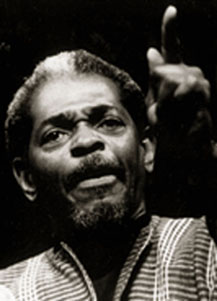 Over the years the Chairman has always had complete unwavering faith in the tremendous ability of the African working class to lead the struggle-no matter how great the slander and degradation heaped on them by the U.S. government at any given time. A man who could never be bought, Chairman Omali has always tried to set an example with his life that death or prison are preferable to slavery or being on your knees. For more than 30 years his devotion to the struggle has been limitless, sometimes at the expense of his most basic personal needs. You couldn't talk about the Chairman without admiring his extraordinary courage. In any struggle or attack he will be the first to the front lines to defend the people regardless of the personal price to himself. His hunger for knowledge is enormous, and he will spend his last dollar on newspapers and books. Although he is a man whose brilliance and intellectual powers have developed a political theory which will transform the future of this whole planet, he has never separated himself from the masses of African people. He would stand on the street corner talking to his countless friends in the neighborhood about anything from the best blues record, to the latest Tyson fight to the political situation in Nigeria. He is hard at work at the Uhuru House every day but will interrupt any pressing project or meeting to greet the children who can't wait to see him. The needs of the people have always been his greatest concern, and even in the heat of struggle he will make sure that the people have enough food and shelter. A strict vegetarian, Chairman gave up smoking and drinking in his 40s and transformed himself physically by running and body-building. A man of great wit and humor, the Chairman is able to make fun of the oppressors, exposing them for the ridiculous and powerless cowards that they are. He has a genius for strategy and can turn any attack by the government into a victory for the people. One of the best examples of both his wit and his strategy may be when the police came in full riot gear to evict the Party from the first Oakland Uhuru House after two years of a rent strike against an exploitative slumlord. Little did the police know that during the night before the Party and supporters had moved the entire contents of the building to a new center down the street. All the next day, though, the comrades from the movement demonstrated outside of the empty Uhuru House, chanting, "Comrades, Comrades, we can win, if just don't let them in!" as if the Party was inside to defend the building. When the police finally broke down the doors, ready for a shoot-out, the place was completely empty. All the Africans who had gathered in the street to watch had a good laugh that day! Omali Yeshitela is genuinely a man of African people and a leader for all of humanity who aspire to a future of justice and freedom. | |||
|